
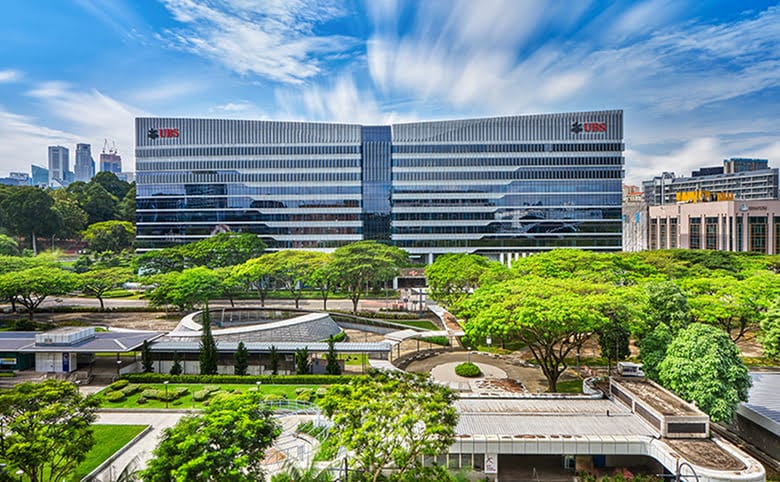
The UBS offices at 9 Penang Road (Image: Tang Organization)
Singapore-listed Suntec REIT’s manager has identified 9 Penang Road, a commercial block in the Orchard Road area owned by its new sponsor, as a potential acquisition target, offering an early signal of deal flow following Tang Organization’s takeover of the trust’s manager.
The eight-storey office building, which serves as the Singapore home of Swiss banking giant UBS, “could be a potential pipeline for Suntec REIT”, the manager said in response to a unitholder question ahead of its annual general meeting.
The comment marks the first indication that Tang Organization may look to recycle assets into the REIT after acquiring its manager from ESR via Acrophyte Asset Management in March. The Orchard Road property occupies a prominent site near Dhoby Ghaut, one of Singapore’s busiest transport interchanges and a key retail node along the city’s prime shopping belt.
The Tang family, which controls the sponsor, is also Suntec REIT’s largest unitholder. A potential acquisition would reverse an earlier divestment, with the REIT having sold its stake in 9 Penang Road five years ago to a vehicle linked to the clan headed by mainland-born tycoon Gordon Tang. A sponsor-led injection would enable portfolio expansion without development risk.
Passing on Trophy Stakes
The manager also used the AGM responses to explain why Suntec REIT opted against acquiring additional stakes in One Raffles Quay and Marina Bay Financial Centre Towers 1 and 2 from Hongkong Land. Until February, the trust held the prime Singapore office assets in a consortium with the Jardine Matheson-controlled builder and SGX-listed Keppel REIT, with each party owning a one-third stake.
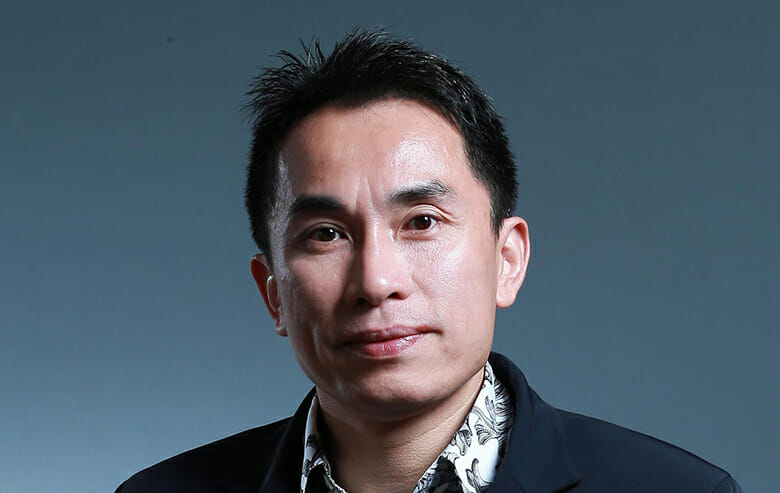
Gordon Tang’s family-controlled group sponsors Suntec REIT
While describing the assets as high-quality and well-located, the manager said pricing meant any acquisition would likely have required full debt funding, pushing the REIT’s leverage above 45 percent for the equivalent of a one-sixth stake.
Issuing equity to fund the purchase would have been dilutive to both net asset value and distribution per unit, given the REIT’s trading discount to net asset value — though the manager noted that the gap had narrowed to 29 percent at the end of 2025 from 43 percent a year earlier.
Hongkong Land has since sold its one-third interests in the Marina Bay assets into a Singapore-focused private fund backed by the Qatar Investment Authority and APG Asset Management, while also increasing its exposure to Suntec REIT through the purchase of a 10.8 percent stake from ESR last month.
Rates Outlook and Risk Planning
Suntec REIT is undergoing a strategic reset following the change in control of its manager, which is working with the board and the new sponsor to undertake a comprehensive review of the portfolio aimed at strengthening performance and enhancing capital efficiency.
The review follows the March completion of the manager acquisition, which also triggered board changes and the appointment of new independent directors. Despite the transition, the manager described operations as “business as usual”, while signalling a disciplined approach to capital and portfolio management.
The REIT’s S$11.8 billion ($9.3 billion) portfolio spans Singapore, Australia and the UK, with holdings in the Southeast Asian financial hub that include Suntec City mall, a two-thirds interest in Suntec Singapore Convention & Exhibition Centre and a 53.9 percent interest in the Suntec City office towers.
The manager flagged a shift in interest rate expectations, with earlier forecasts of steady cuts giving way to a more cautious, wait-and-see stance in Singapore and the UK, and tightening in Australia. About 65 percent of Suntec REIT’s borrowings are on fixed rates or hedged, limiting near-term exposure to rate volatility, with financing costs in 2026 expected to remain broadly in line with 2025 levels barring unforeseen events.
In a stress scenario, a 100-basis-point rise in interest rates would increase borrowing costs by S$19.2 million and reduce distribution per unit by 0.65 Singapore cents, based on internal sensitivity analysis. The manager said a return to double-digit interest rates akin to the 1970s oil crisis was unlikely given differing economic conditions.
Leave a Reply