
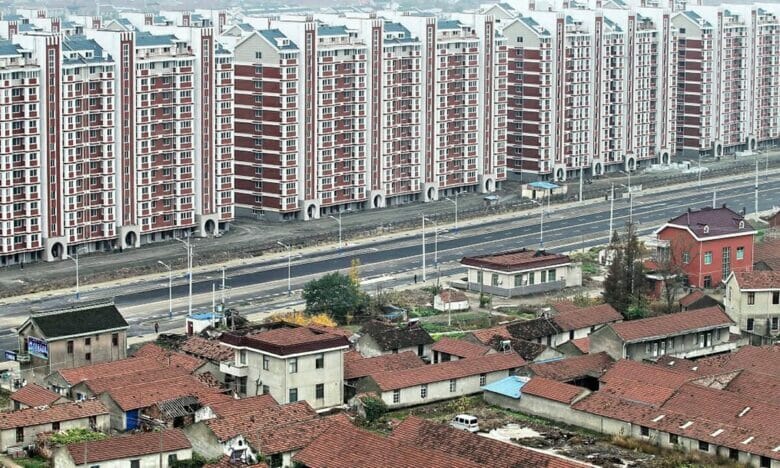
JP Morgan expects the housing crisis to linger longer in China’s lower-tier cities (Getty Images)
JPMorgan Chase & Co expects home prices in China’s four largest cities to stabilise in 2026, with Shanghai set to lead gains as the secondary market shows early signs of recovery.
Second-hand prices across Beijing, Shanghai, Guangzhou and Shenzhen rose 0.4 percent in March from February, government data showed, the first monthly gain since the first quarter of 2025. Property agency Centaline reported a stronger 0.9 percent rise, the second consecutive month of growth.
“Encouragingly, unlike previous months with positive growth which were driven by nationwide easing or a change in the government’s attitude, this time the improvement appears organic,” said Karl Chan, head of mainland China and Hong Kong property research at JP Morgan, in a report published last week.
Chan’s team attributed the gains to a combination of rising stock market wealth, improving affordability and a confidence boost from Hong Kong’s housing recovery, where prices have rebounded 14 percent from their March 2025 trough.
Shanghai Turnaround
JPMorgan forecasts second-hand home prices in Shanghai will climb two percent in 2026, making it the strongest performer among the four cities. Beijing and Shenzhen are expected to be broadly flat, while Guangzhou faces a projected three percent decline from last year’s prices.

Karl Chan of JP Morgan sees a Shanghai rebound
The bank is most positive on Shanghai, where secondary market inventory months — the time it would take to sell all available housing stock at the current pace of transactions — stood at around 14 as of March, the lowest in four years. Supply and demand dynamics in the city are also the healthiest among all four tier-one cities, JPMorgan said.
China’s benchmark CSI 300 Index has risen about 24 percent since April last year, and JP Morgan sees the delayed wealth effect from those gains contributing to housing demand in major cities.
Despite the positive signals, JP Morgan says significant headwinds remain. Primary inventory stands at around 22 months and secondary at 19 months, the unemployment rate is trending upward and rents in tier-one cities remain on a downtrend.
Lower Tier Cities Lag
JPMorgan does not expect the improvement to extend beyond the largest cities in the near term, with the exception of select markets such as Hangzhou. The bank forecasts home prices in non-tier-one cities will fall five percent in 2026.
“We believe it may take at least six to 12 months for positive market sentiment to spread from tier-one cities to tier-two, three and four cities,” Chan’s team said.
Tier-one cities account for only 10 to 15 percent of China’s national residential sales value, limiting the broader impact of any recovery even if the stabilisation thesis plays out, JPMorgan noted.
Nationally, China’s new-home prices fell 0.21 percent in March from February, the slowest pace of decline in about a year, according to NBS data released on 16 April. Real estate investment fell 11 percent year-on-year in March, new housing starts dropped 17 percent and completions declined 19 percent, the data showed.
JPMorgan is not alone in predicting stabilisation of home prices in China. Goldman Sachs said in a research note earlier this month that home values across an expanding number of first and second-tier cities are expected to stabilise over the next one to two years, with Shanghai and Shenzhen leading the upturn.
At the same time, the investment bank warned lower-tier markets will not see a swift recovery, weighed down by oversupplied housing stock, ongoing population outflow and weak fiscal fundamentals.
Leave a Reply