
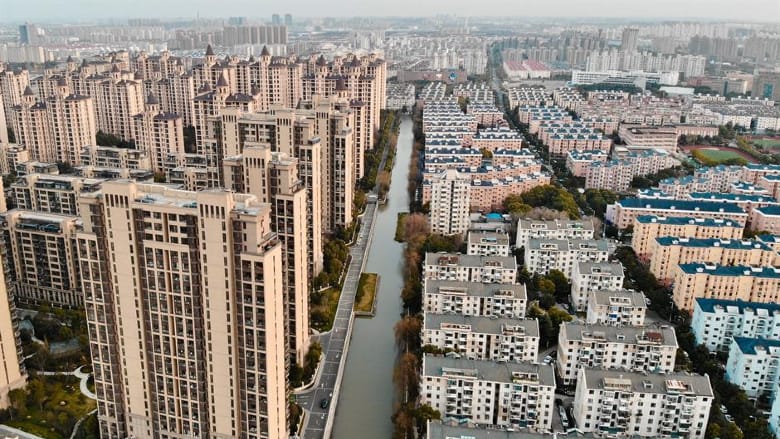
Shanghai led China’s home price increases in March
Prices for new homes in China fell at a slower pace in March, declining by 0.08 percent month on month compared with a 0.14 percent slide in February, according to government statistics released on Thursday.
During last month, 24 of the 70 cities surveyed by China’s National Bureau of Statistics reported price increases for non-subsidised housing, six more than in February, and overall price declines on a year-on-year basis have narrowed, said Wang Zhonghua, chief statistician with the bureau’s Urban Department.
Second-hand home prices fell 0.23 percent in March, narrowing from a 0.34 percent drop in February, according to figures cited by European Bank ING.
“Despite continued declines, the data once again offers some reasons for optimism. For example, 29 cities saw new home prices stable or increasing, while 14 saw used home prices stable or rising,” said Lynn Song, chief economist for Greater China at ING.
“This data suggests that property prices are in the process of establishing a trough,” Song said.
Shanghai and Hangzhou Lead Recovery
The biggest jumps in home prices were reported in Shanghai, Hangzhou and Chengdu which saw increases of 0.7 percent, 0.5 percent and 0.5 percent, respectively. Five cities saw new home prices remain stable and 41 cities reported price declines.
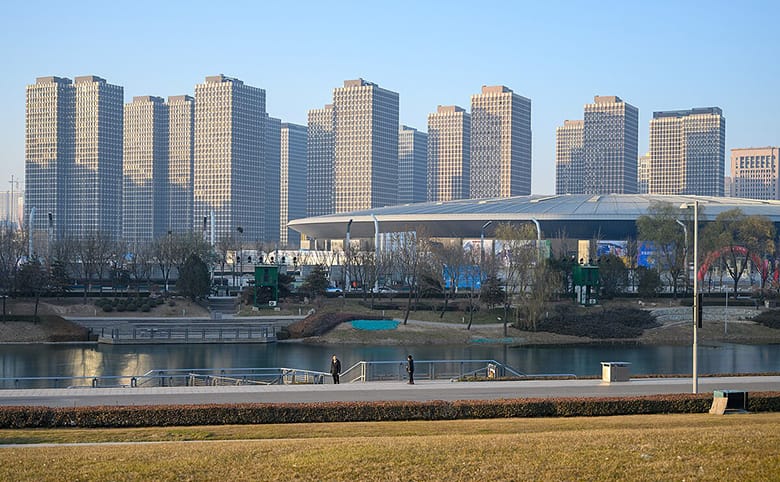
Taiyuan home prices also moved northward in March
The second-hand home market showed a weaker picture, with prices rising in 10 cities, compared to three the previous month. Hangzhou, Beijing and Shanghai led the rebound, with upticks in second-hand home prices of 1 percent, 0.5 percent, and 0.4 percent, respectively. Four cities saw second-hand home prices remain flat against February, and 56 cities saw price declines.
On a year-on-year basis, prices of new homes fell in nearly all cities surveyed by as much as nearly 9 percent, but at a slower rate than in earlier months. The only exceptions to this annualised drop in prices were Shanghai and the Shanxi provincial capital of Taiyuan which recorded new home price increases of 5.7 percent and 1 percent respectively. Compared to March 2024 prices for second-hand homes were down in all cities, declining by as much as nearly 11 percent.
“Amid China’s attempt to increase confidence and boost domestic demand, we believe that stabilising the property market remains a paramount priority. It’s difficult to imagine consumers spending confidently as long as their biggest asset continues to lose value every month. March data should be seen as another small step in the right direction,” said Song.
Investment Continues to Slide
In recent months, Beijing has repeatedly pledged to stabilise the property market while local governments have rolled out city-specific measures to ease home-buying curbs and stimulate demand. Despite these measures, sales of new private homes continue to struggle.
The value of developer sales of new homes fell 0.4 percent year-on-year in the first three months of 2025, while sales were down 2 percent by floor area.
With consumers keeping their cash in their pockets, developers continue to hold back on new investments, with NBS figures showing that total investment in the property industry fell 9.9 percent year-on-year in the first three months of 2025 to RMB 2 trillion ($275 billion).
In March alone, property investment fell 10.3 percent from a year prior to RMB 918.4 billion, according to Mingtiandi calculations based on NBS data, with the decline widening from 9.8 percent in the January to February period.
The housing slump was also reflected in the kickoff of new projects with construction starts by floor area slumping 18.8 percent in March to 63.8 million square metres (687 million square feet), although this decline narrowed compared with the 29.6 percent year-on-year drop reported in the first two months.
China recorded stronger-than-expected GDP growth of 5.4 percent in the first quarter, according to data released by NBS on Wednesday.
ING’s Song expects that second-quarter growth will likely suffer from the escalation of US president Donald Trump’s trade war. In recent weeks Trump has boosted tariffs on Chinese goods to 125 percent while China has retaliated by slapping 125 percent levies on US goods.
In the face of these headwinds, ING’s Song predicts that China will likely take additional measures to meet this year’s growth target of “around 5 percent” with the analyst expecting that the People’s Bank of China may cut interest rates by 30 basis points and reduce bank reserve requirement ratios (RRR) by 100 basis points.
Leave a Reply