
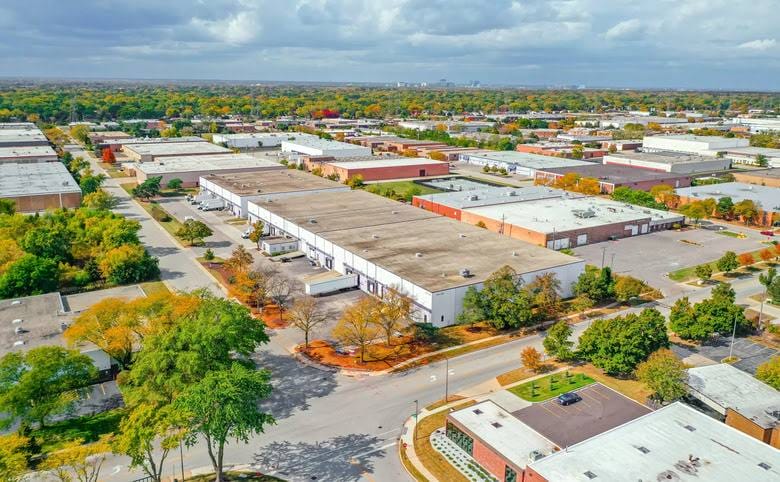
Mapletree sold 950-1000 Lunt Avenue in Chicago earlier this year (Image: Mapletree)
Singapore’s Mapletree Investments posted a 25.7 percent rise in annual profit as its core logistics business accelerated and revaluation losses narrowed, even as the Temasek-owned manager wound down funds that faced headwinds in student housing and Australian offices.
Profit after tax and minority interest climbed to S$285.6 million ($223.4 million) for the Temasek Holdings portfolio company’s fiscal year ended 31 March 2026, up from S$227.2 million a year earlier, the company said Tuesday in a release. Recurring PATMI — which strips out revaluation swings — rose to S$622.8 million from a restated S$606.6 million.
Assets under management fell to S$76.2 billion from S$80.3 billion a year earlier as the group completed exits from several maturing private fund vehicles, including its US and European logistics trust and its Mapletree Global Student Accommodation Private Trust.
“Mapletree delivered stable earnings and continued to execute its business strategy with discipline and prudence amid ongoing macroeconomic and geopolitical uncertainties,” said Hiew Yoon Khong, Mapletree’s group chief executive officer. “We accelerated the development programme of our global logistics platform across multiple markets and continued to recycle capital, syndicate assets and grow our fee-based businesses.”
Warehouses Lead the Way
Logistics remains Mapletree’s largest asset class, representing 42.5 percent of total AUM at S$32.4 billion, and the company pointed to development as its preferred mode of growth over acquisitions. Mapletree completed 10 logistics projects in the year and awarded contracts for 12 more.
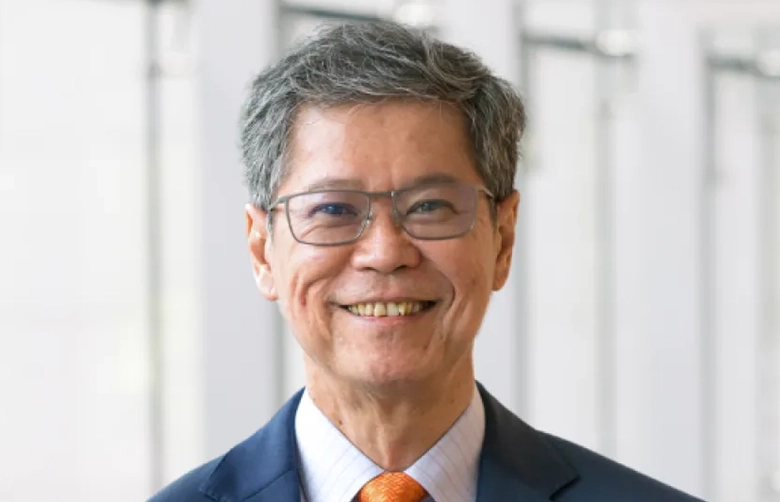
Mapletree Investments CEO Hiew Yoon Khong
The Singaporean firm had S$2.6 billion of logistics projects under development as at 31 March 2026, part of a S$5.4 billion total development pipeline spanning four core sectors, which also include office, student housing and data centres.
In Asia, the group delivered six logistics parks in China totalling approximately 600,000 square metres (6.5 million square feet) of net lettable area, acquired a 118,629 square metre site in Malaysia’s Shah Alam for a 321,000 square metre facility, and completed its Mapletree Logistics Park Hoa Phu 2 development in Vietnam’s Bac Ninh province.
In the US, Mapletree had approximately $500 million of projects under construction as of 31 March, targeting completion between the second half of 2026 and 2027, after acquiring three sites across Illinois and Pennsylvania during the year.
In Europe, the group bought two premium logistics assets in the Netherlands and broke ground on a build-to-suit facility in Poland.
Emerging Markets Fund Nears First Close
Mapletree said it is on track to achieve a first close by mid-2026 for its Mapletree Emerging Growth Asia Logistics Private Trust, a development fund targeting Malaysia, Vietnam and India where institutional-grade warehouse space remains in structural undersupply. A second close is planned later in the year.
The fund, which targets assets under management of up to $1.8 billion and mid-teens returns, has secured equity commitments from a sovereign wealth fund, a pension fund and a national investment company, the company said.
The vehicle’s seed portfolio includes two projects in Vietnam, four in Malaysia and one in India.
Fund Wind-Downs
Mapletree’s S$4.2 billion in gross divestment proceeds during the year came largely from the wind-down of maturing private fund vehicles. Mapletree US & EU Logistics Private Trust exited approximately $1.5 billion of US warehouse assets at returns in line with its 12 percent IRR target, capping a series of disposals to Faropoint, EQT and Dalfen Industrial that began in mid-2025.
The group also disposed of a number of properties from its MASCOT Australian office fund which raised A$654 million in equity in 2019, recorded at least three loss-making exits, including Brisbane’s 144 Montague Road and Melbourne’s 417 St Kilda Road, as it wound down a portfolio assembled near market peak.
The MGSA student housing vehicle, launched in 2017 with $1.3 billion in assets under management, is also being liquidated after earning a net IRR of 1.1 percent against a 12 percent target. Bloomberg reported in March that investors are expected to recover less than 80 cents on the dollar from remaining assets.
Student Housing Shift
Despite MGSA’s difficulties, Mapletree has maintained its conviction in student housing, entering Australia’s student housing market in August 2025 with the purchase of a site on Wellington Street in Perth for an 835-bed development scheduled for completion in 2027.
At the time of the investment Matt Walker, CEO of student housing at Mapletree pointed to the potential for student housing Down Under, saying, ““Australia’s student housing sector has attracted robust investor interest due to its large student population, limited supply and counter-cyclical features.”
Mapletree also continues to operate more than 17,000 student beds in the UK after completing the $1.3 billion acquisition of 31 Student Castle assets from Cuscaden Peak Investments in April 2024, a deal that made the Singaporean firm the fourth-largest student housing owner in Britain.
Quarter-Century Mark
Mapletree’s fee income grew to S$434 million in the latest fiscal year, up from S$8 million in fiscal 2006, as third-party managed assets — across three Singapore-listed REITs and nine private equity funds — reached S$55.7 billion, or 73.1 percent of total AUM.
In January 2026, the group sold a 10 percent stake in its India commercial assets to a new institutional investor as it continued to deploy capital into office development in Bengaluru, Mumbai, Pune and Hanoi.
Mapletree marks its 25th year of operations in 2026, having grown AUM from S$2.3 billion in 2003, with the company saying it has generated an average return of approximately 10 percent on invested equity over the past two decades without additional shareholder equity injections.
“Our track record over the past 25 years was built through diverse market cycles that challenged and strengthened us,” Hiew said. “The platform we have built gives us confidence in navigating what comes next.”
Leave a Reply