
Hongkong Land is seeking additional opportunities to expand its fund management business after debuting a $6.4 billion Singapore commercial vehicle earlier this year, with CEO Michael T Smith saying the company aims to build a regional platform focused on ultra-premium office ecosystems in Asia Pacific gateway cities.
Speaking Tuesday at the Mingtiandi Singapore Forum, Smith said the Jardine Matheson-controlled company intends to continue moving beyond its historic role as a landlord and developer by expanding its portfolio of private funds concentrated on prime office assets in core financial districts like Singapore’s Marina Bay and Hong Kong’s Central.
“We don’t want to do anything else but this, We’d love to be the Goodman or Prologis or Digital Realty of ultra-premium integrated commercial properties,” Smith said at the Yardi-sponsored event.
Smith’s comments come after Hongkong Land unveiled a strategic pivot to fund management in October 2024, with investors rewarding the shift as the developer’s stock price nearly doubled following the announcement and subsequent February launch of the Singapore Central Private Real Estate Fund.
“So after 136 years, we decided to pivot away,” Smith said, referring to Hongkong Land’s roots dating back to its first land acquisition in Central in 1889. “The stock market has been quite supportive of the transition.”
Marina Bay Platform
The inaugural Singapore vehicle combined Hongkong Land office assets — including one-third stakes in Marina Bay Financial Centre Towers 1 and 2 and One Raffles Quay — with the Qatar Investment Authority’s Asia Square Tower 1. The strategy also attracted outside equity from investors including Dutch pension giant APG and a Southeast Asian sovereign wealth fund.
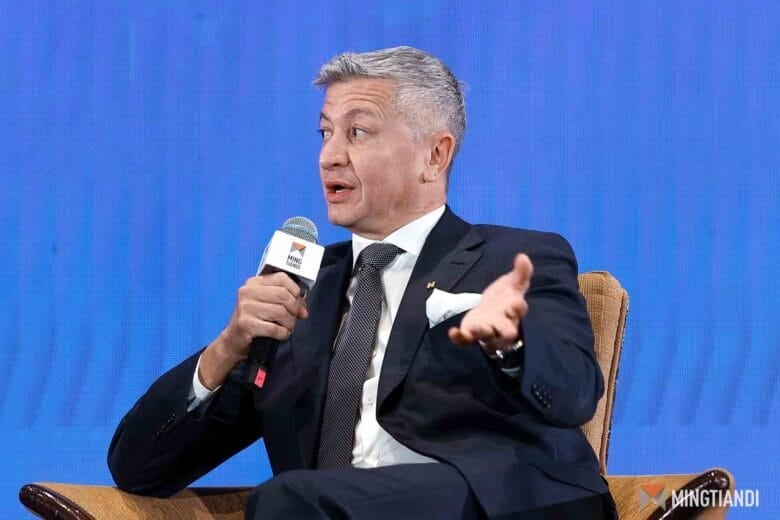
Hongkong Land Group CEO Michael T. Smith (Image: Mingtiandi)
Smith said the structure reflected Hongkong Land’s belief that scale ownership in core business districts provides pricing power and long-term value creation opportunities.
“When you own 12 office buildings in Hong Kong Central, you really are able to dictate pricing,” he told the audience of more than 300 senior industry leaders at the forum, which is sponsored by Yardi.
The executive added that the fund has investor backing to grow from S$8 billion to as much as S$15 billion over time, with acquisitions focused on Marina Bay opportunities provided pricing remains disciplined. Hongkong Land was among bidders for Asia Square Tower 2 but declined to match the winning valuation.
“We’re not going to overpay,” Smith said. “The good thing about having a fund like this with a return hurdle is that you can’t pay more than a certain amount unless you’re really, really optimistic on growth.”
Smith argued that private funds offer advantages over listed REITs because institutional capital is willing to accept lower yields in exchange for exposure to tightly held gateway-city office portfolios. He noted that Hongkong Land’s Singapore fund carries an 8 percent cost of capital versus the higher return expectations typically associated with public REITs.
Still, the CEO remains a champion of public REITs, having played key roles in the listings of Hong Kong’s Link REIT and all four of Mapletree’s Singapore-listed REITs during earlier stages of his career.
“I’m a big believer in public REITs,” Smith said. “They work at certain points in certain cycles.”
Hongkong Land has also continued deploying capital into Singapore through its $422 million stake acquisition in Suntec REIT after the Tang family acquired control of the trust’s manager from ESR. Smith said the investment reflected a valuation opportunity because the REIT owns stakes in MBFC 1 and 2 and One Raffles Quay alongside Hongkong Land.
Capital Management Push
Smith linked Hongkong Land’s transformation to broader changes within Jardines under the Keswick family, which has controlled Jardine Matheson since the 19th century. The family’s willingness to shift from an owner-operator model towards capital allocation and shareholder value creation was a key factor behind the overhaul.
“The Keswicks involved in the business made a conscious decision … their preference is to be a capital allocator rather than an owner-operator,” Smith said.
The executive pointed to the hiring of former PAG partner Lincoln Pan as CEO of Jardine Matheson as evidence of the conglomerate’s push towards professional management and value creation initiatives.
Smith said Hongkong Land has also assembled a leadership bench reflecting its fund management ambitions, including former APG APAC head Graeme Torre overseeing the Hong Kong portfolio and Blackstone veteran Stuart Grant leading the developer’s Westbund Central project in Shanghai. Board members now include GLP founder Ming Z Mei and Blackstone executive Alan Miyasaki.
“I personally think that real estate in a fund format is the most efficiently run real estate,” Smith said, adding that Hongkong Land now expects portfolio chiefs to manage assets with fund-style return disciplines and accountability.
Hong Kong Rebound
Discussing Hongkong Land’s home market, Smith said leasing momentum in Central has accelerated as legal firms, hedge funds and private equity groups expand amid a revival in Hong Kong IPOs. Vacancy across core Central buildings has tightened to roughly 3 to 4 percent, he said.
“Every single law firm is just running out of space,” Smith said. “Private equity needs more space. Hedge funds need more space.”
While acknowledging elevated vacancy in Kowloon East and Hong Kong East, Smith argued that premium downtown ecosystems like Central remain structurally advantaged over competing office hubs like West Kowloon, as financial and professional tenants continue to gravitate towards established clusters offering luxury retail, hospitality and transport connectivity.
“We believe in gateway cities,” Smith said. “If in 2035 Hongkong Land would just focus on those six cities and we had Central-type equivalents in each of them, then I’d be very happy with that.”
Leave a Reply