
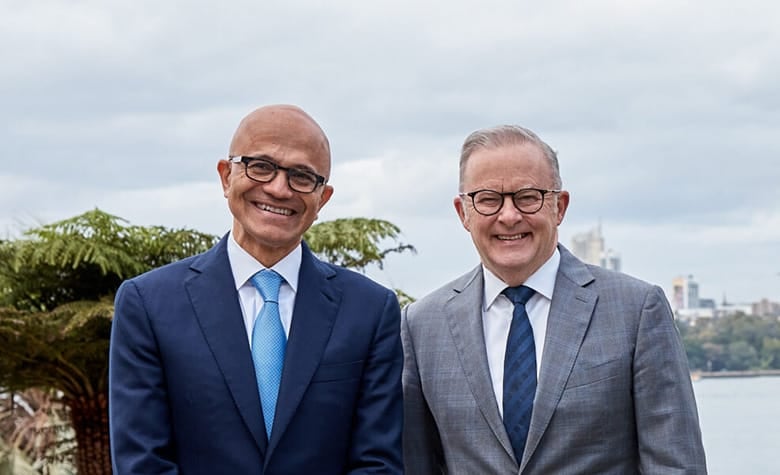
Microsoft’s Satya Nadella talking AI with Prime Minister Anthony Albanese (Image: Microsoft)
Microsoft is making its biggest investment yet in Australia, with the tech company saying on Thursday that it plans to spend A$25 billion ($18 billion) to build data centres and digital resources to support AI development in Australia, with the announcement coming in the same month that the company promised a $10 billion AI campaign in Japan.
Microsoft chairman and CEO Satya Nadella announced the move alongside Australian Prime Minister Anthony Albanese, laying out a plan to build data centres and related infrastructure, train workers in using artificial intelligence and provide protection against cyber attacks. The blueprint covers the years up to 2029 and comes after Microsoft said in 2023 it would spend A$5 billion to build data centres in the country.
With artificial intelligence investors favouring Australia’s connectivity, open spaces and strong property rights, Nadella voiced confidence in prospects for developing the technology in the country. “Australia has an enormous opportunity to translate AI into real economic growth and societal benefit. That is why we are making our largest investment in Australia to date,” Nadella said.
Microsoft’s Australia initiative aligns with a wave of investment by the company and competitors such as Alphabet and Amazon, with investment house Bridgewater Associates predicting earlier this year that US tech giants will invest around $650 billion this year expanding their infrastructure to meet AI requirements.
Doubling the Data Centre Footprint
Microsoft said it is committing the funds to expand AI supercomputing capacity and to install the processing capacity needed to support next generation applications, “with plans underway to expand our existing footprint by more than 140 percent by the end of 2029.”
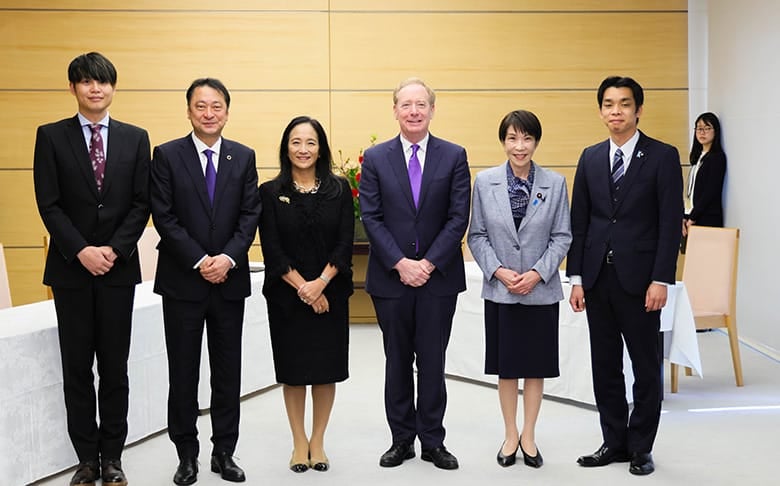
Microsoft’s Brad Smith (centre) meeting Japanese Prime Minister Takaichi earlier this month (Image: Japanese govt)
The initiative by the Seattle-based firm marks the latest multi-billion dollar digital infrastructure commitment in Asia Pacific by a US hyperscaler, after Microsoft said in December that it would spend $17.5 billion developing AI infrastructure in India, with Amazon saying that it would spend $35 billion on a similar initiative.
In early April Microsoft vice chair and president Brad Smith visited Japan to announce $10 billion in developing an AI ecosystem there, putting the Windows-maker’s commitments to the technology across major Asia Pacific economies at $45.5 billion in less than six months.
Microsoft’s data centre push into Australia has focused on Sydney and Melbourne where the company has a trio of operating facilities with another three under development, according to a presentation released in October. The company’s Kemps Creek Datacenter is scheduled to open this year in western Sydney, where an infrastructure boom is underway around the construction of a new airport that also opens in 2026.
With the new investment, Microsoft signed an agreement with the Australian government to abide by its recently released expectations for development of datacentres and AI infrastructure, which include helping to drive the country’s clean energy transition, using water sustainably and investing in Australian jobs.
Microsoft said these expectations align with its own internal commitments to use 100 percent renewable energy. The company also said that the government’s expectation that data centre investors strengthen local research and innovation coincides with Microsoft’s cloud-based development platform and access programs for Australian startups.
Renewable Energy Drive
With access to clean energy growing in importance for digital infrastructure investors needing to power electricity-hungry AI facilities while aligning with the sustainability targets of global investors, major players in the sector have been rolling out more projects in Australia, which is outpacing much of Asia Pacific in developing alternatives.
“Australia’s renewable energy potential, particularly in solar and wind makes it an attractive location for green data centres,” consultancy BDO said in a profile of Australia last year, which pointed to the country’s location on global networks as another positive.
“As a stable, English-speaking nation with strong ties to Asia, it serves as a regional hub for cloud services and data routing. Submarine cable networks connecting Australia to Southeast Asia and the US further enhance its appeal. This connectivity is particularly attractive to rapidly scaling tech companies looking to serve both domestic and regional from a single, secure base,” BDO said.
Recent investments are matching those expectations, with Australian data centre operator NextDC this week saying its customer demand for capacity has jumped 60 percent in this year, prompting it to raise $1.6 billion to fund expansion.
In February, PGIM Real Estate said it acquired a site in western Melbourne for a data centre with the investment manager planning to spend $850 million on building the first phase of the project.
Leave a Reply