
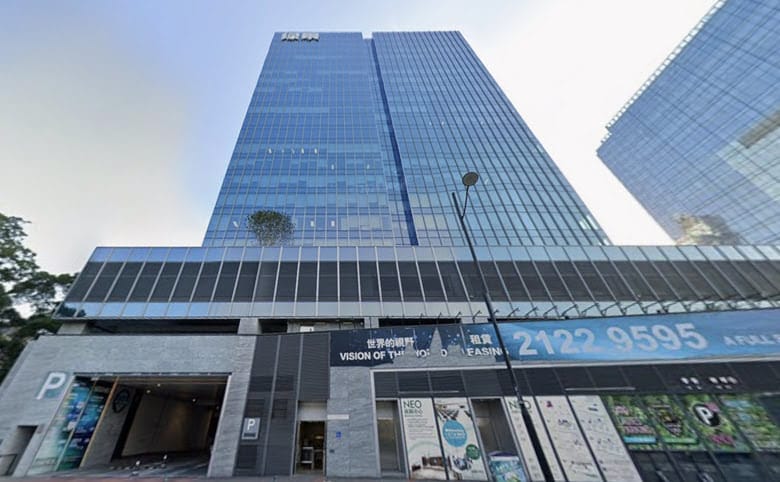
Neo in Kowloon East was completed in 2019 (Image: Google)
Receivers have put a Kowloon East office tower on the market, appointing agents to seek a buyer for a waterfront property once emblematic of mainland Chinese investment into Hong Kong’s office sector.
The 19-storey building, known as Neo, was acquired by Shenzhen-based developer LVGEM from Wheelock and Co’s Wharf property unit in 2017 on a forward basis for HK$9 billion ($1.2 billion). LVGEM is understood to owe Bank of China around HK$5 billion on a loan secured by Neo, which the Hong Kong-listed builder attempted to sell in late 2025 at an asking price of HK$6 billion, according to market sources who spoke to Mingtiandi.
Savills and Colliers have been appointed to market the 19-storey tower at 123 Hoi Bun Road in Kwun Tong district, with the sale to be conducted by tender, the agencies said Thursday in a release. Completed in 2019, Neo spans 567,000 square feet (52,676 square metres) of rentable area and is being sold “as is”, partly with vacant possession and partly with existing tenancies.
“The property can be flexibly divided into east and west towers, each with independent lobbies and naming rights, offering buyers immense brand promotion opportunities and flexibility for business expansion,” said Raymond Wan, chief senior director of investment at Savills Hong Kong.
On the Waterfront
LVGEM’s purchase of Neo, formerly known as 8 Bay East, was part of a broader sell-down by Wheelock of newly built office blocks along the Kowloon East waterfront.

LVGEM executive director and chairman Huang Jingshu (Image: LVGEM)
In 2015, China Life acquired One HarbourGate West for HK$5.86 billion, marking one of the earliest large-scale purchases in the precinct by a mainland corporate. The following year, Cheung Kei Holdings, controlled by Shenzhen tycoon Chen Hongtian, bought One HarbourGate East for HK$4.5 billion to serve as the group’s Hong Kong headquarters.
Those deals underscored aggressive mainland buying in Hong Kong commercial property during the mid-2010s, often supported by high leverage and expectations of continued capital appreciation. Subsequent market shifts exposed vulnerabilities in those investments, particularly as financing conditions tightened and office demand weakened.
Cheung Kei later defaulted on debt tied to One HarbourGate East, with receivers taking control of the asset. In 2024, the property was sold to Hong Kong Metropolitan University for HK$2.65 billion, representing a steep discount to its earlier HK$7 billion valuation in 2022.
The disposal highlighted the scale of value erosion in Kowloon East office assets, raising questions about pricing expectations for similar buildings now being marketed. Against that backdrop, the sale of Neo is expected to test investor appetite for large-scale office acquisitions in a market still searching for a floor.
Widening Loss, Wind-Up Woes
Founded in 1995, LVGEM has traditionally focused on residential developments in its home city of Shenzhen and elsewhere in Guangdong province.
The group has a single Hong Kong project, a residential development expected to yield 116 waterfront villas in the New Territories area of Lau Fau Shan, but it remains in the planning stage.
Led by executive director and chairman Huang Jingshu, LVGEM warned last month of an expected 2025 loss of RMB 9.7 billion ($1.4 billion), widening from a year-earlier RMB 5.4 billion, driven by fair-value and impairment markdowns.
A hearing on a winding-up petition filed against LVGEM by a lender last year has been adjourned until June, with further updates to be made when appropriate, the company said.
Leave a Reply