
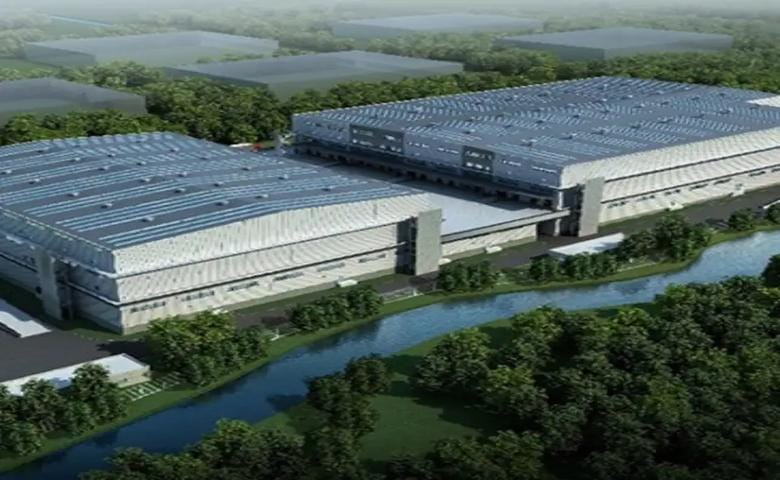
ESR’s China portfolio includes Shanghai Qingpu Huitong Park (Image: ESR)
ESR has launched an onshore income fund with total investment capacity of RMB 1.6 billion ($235 million), targeting stabilised industrial assets in eastern China as the group advances its capital recycling strategy.
The new vehicle is acquiring two logistics properties in Shanghai and Suzhou with a combined gross floor area of 320,000 square metres (3.4 million square feet), ESR said Tuesday in a release. Backers of the fund include two mainland Chinese insurers, one an existing capital partner and the other a first-time investor with ESR, the Singapore-based company said.
ESR will retain a minority interest in the vehicle, with the recapitalisation providing an exit route for mature assets while preserving exposure through the group’s remaining stake and management fees. The properties being injected into the fund weren’t identified but were described as stabilised, income-generating facilities in core Yangtze River Delta markets.
“We continue to see strong alignment with long‑term institutional capital that recognises the resilience and strategic importance of modern logistics real assets in China,” said ESR co-founder and co-CEO Jeffrey Shen. “This transaction reflects our ability to partner at scale with domestic institutions to access growth opportunities and our long‑term conviction in high‑quality assets.”
Pivot to Core Platforms
The latest deal comes after ESR partnered with a mainland insurer three years ago to launch its largest-ever onshore income fund. That vehicle, with an investment capacity of RMB 10 billion, was seeded with a logistics portfolio of balance-sheet assets spanning over 350,000 square metres and valued at RMB 2.3 billion.
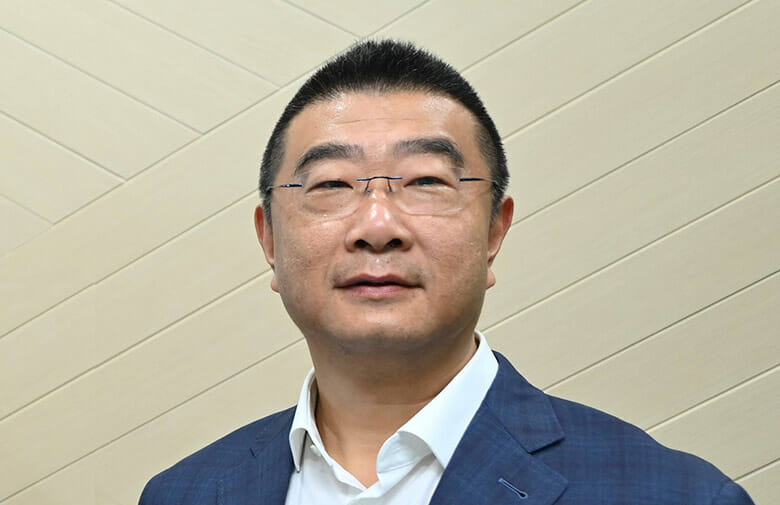
ESR co-founder and co-CEO Jeffrey Shen (Image: ESR)
ESR has been among the most active players in recycling assets in China, aligning with broader efforts to streamline the company following last year’s $7 billion privatisation. The group-wide pivot is aimed at simplifying operations and sharpening focus on scalable platforms for logistics, data centres and infrastructure.
This month ESR announced an $850 million equity raise from existing shareholders to provide dry powder for the group’s next phase of expansion. The news followed a burst of asset sales, with ESR divesting non-core properties and legacy businesses inherited from its $5.2 billion acquisition of ARA Asset Management.
Since January 2025, the group has generated more than $2 billion in net proceeds from such disposals, most recently exiting its stake in European credit platform Venn Partners.
The group sold ARA’s private funds business, comprising 22 vehicles with $9.8 billion in assets under management, for $270 million in 2024, while also exiting ARA US Hospitality Trust and its manager that same year.
ESR divested its stake in Australia’s Cromwell Property Group through a series of transactions in 2024 and 2025, and last month it fully exited Singapore-listed Suntec REIT and its manager.
GLP’s Parallel Path
ESR rival GLP has been pursuing a similar approach in China, including the September closing of its 14th onshore income fund with RMB 2 billion in assets under management.
GLP China Income Fund XIV, a partnership with a “leading global institutional investor”, was seeded with five stabilised logistics and business park assets from GLP’s balance sheet.
The milestone came nine months after the Asian warehouse specialist reached the closing of its 13th mainland China income fund with RMB 2.8 billion in assets under management.
In March last year, GLP sold its fund management business outside of China to US-based Ares Management for over $5 billion. After the transaction, GLP managed $80 billion in assets with $6 billion in unimplemented capital in its funds.
GLP retained its stakes in the ex-China funds now managed by Ares and also invested in the Los Angeles-based firm’s first Japan data centre fund, which reached a $2.4 billion final closing in June.
In August, GLP announced RMB 2.5 billion in investment from Zhejiang government entities and a capital commitment of up to $1.5 billion from the Abu Dhabi Investment Authority.
Leave a Reply