
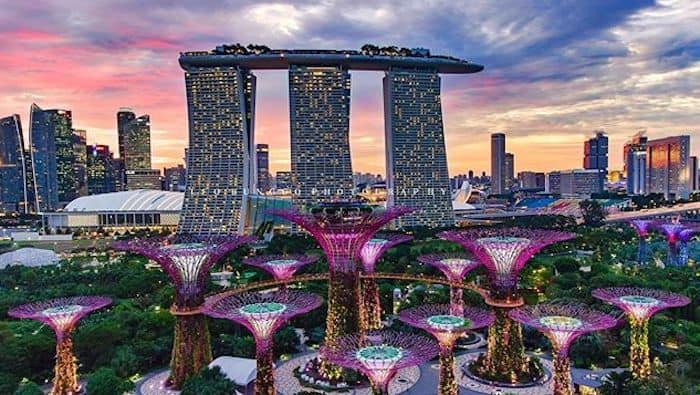
Tourists visiting Singapore usually take pictures with the Marina Bay Sands as backdrop.
Singapore’s hospitality sector is expected to lead its Asia Pacific competitors as travel recovers around the region, with occupancy rates and room revenues seen returning to their pre-pandemic levels by late 2024, according to a report by Schroders Capital on Wednesday.
“The Singapore hospitality sector has got off to a strong start in the recovery race,” Schroders APAC head of strategy and investor advisory Andrew Haskins said in the report. “The strong recovery should continue over the next few years, given high demand and modest supply, and Singapore hotels in aggregate should achieve significant growth in revenues and operating profit.”
The UK asset manager’s researchers found that hotel occupancy in the Lion City, where demand for rooms comes mostly from international tourism and corporate travel, hovered around 72 to 73 percent in the eight months ending 31 August, surpassing the 60-70 percent average recorded by other developed APAC markets.
Citing data from CBRE, Schroders’ analysts say it may take at least two years for the city to state’s hotels to average 87 percent occupancy and achieve operating cash flow matching pre-crisis levels. Still the company sees this as the best results being achieved in Asia Pacific, with Singapore poised to lead the race to travel recovery.
Limited Rooms Support Revenue Growth
After seeing hotel occupancy drop to 20 to 40 percent during the depths of the coronavirus pandemic, CBRE data shows that Singapore’s 72 to 73 percent of rooms filled represents the highest percentage of hotel bookings regionally in the January through July period, followed by Australia and South Korea which both reported average occupancy of 67 percent.

Andrew Haskins of Schroders Capital
Schroders pointed to Singapore’s role as a regional financial hub coupled with traditional tourist traffic and casino visitors in bringing both foreign tourists and business travellers to the Little Red Dot.
The city recorded 730,000 international arrivals in August 2022, which was equivalent to nearly half the monthly 1.6 million visitors averaged before the pandemic hit in March 2020. Citing CBRE forecasts, Schroders said monthly international arrivals will likely return to 2019 levels by late 2023 or early 2024.
In terms of revenue, Singapore is not the top-earner in the region but a limited supply of hotel rooms in the land-scarce city bodes well for top line growth. There are only 75,000 existing hotel rooms in the city, which is expected to increase by just 6 to 7 percent in the next four years.
In the first seven months of the year, the average daily rate (ADR) for hotels in the city-state was already 5 percent higher than the ADR in July 2019, based on data from hospitality analytics firm Smith Travel Research (STR) cited in the Schroders report.
If the number of filled rooms is considered, revenue per available room (RevPAR) was still down 15 to 20 percent from pre-pandemic levels. The STR data showed Australia and South Korea were the only developed markets in APAC that saw both ADR and RevPAR surpass 2019 levels.
“Not only is the demand outlook strong, but also new supply is modest,” Schroders said. “Demand and supply are well-balanced across most market segments, but occupancy is increasingly being driven by new luxury offerings.”
CBRE estimates Singapore hotels’ RevPAR will not surpass 2019 levels until 2024.
Tourists Return
Following closely behind Singapore in the hotel recovery race is Japan. Schroders sees travel in Asia’s second largest economy continuing to benefit from stable domestic tourism while reporting a sharp rebound from foreign travelers lured in by a Japanese yen as soon as the government began lifting restrictions on leisure travels starting in June.
“The Japanese government has recently announced the restoration of visa waiver arrangements for vaccinated foreign tourists and removed a daily cap on visitors,” Schroders’ Haskins said. “Following this easing of entry rules, we expect that Asian inbound visitors will rebound sharply. The continuing weakness of the yen should support their return,” he added.
In the eight months to August, average occupancy in Japanese hotels has already exceeded its pandemic low of 60 to 65 percent but remains below the 2019 average of 80 percent.
ADR and RevPAR in Japan also remained 25 percent and 45 percent below 2019 levels, respectively, as international visitor levels remained muted. In a bid to boost tourism, Japan fully reopened its borders to foreign visitors this month by reinstating visa-free travel to citizens of over 60 countries and lifting one of the strictest travel curbs in the world. This, after only allowing group tours in June.
Schroders, a UK-based fund manager with $940 billion of assets under management globally, expanded in Japan earlier this year with establishment of local real estate operations led by former JP Morgan Asset Management executive Keisuke Kusano.
Leave a Reply