
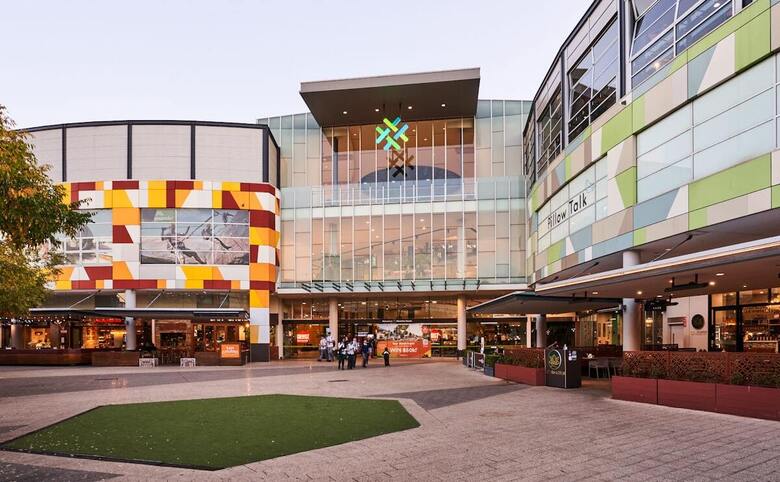
Macarthur Square in Campbelltown is among Link’s latest Aussie targets (Image: Macarthur Square)
Link REIT pointed to an active future in Singapore and Australia on Thursday after Asia’s largest property trust booked a 3.4 percent decline in net property income for the six months ended 30 September.
The Hong Kong-listed titan, which recently made an unsolicited offer for a set of retail assets in Australia, saw lower rents at its commercial properties in Hong Kong and mainland China pull down its revenue for the April through September period by 1.8 percent year-on-year to HK$7.02 billion ($901 million), according to its interim results released on Thursday.
Link REIT Chair Duncan Owen said at a news conference following the results’ release that the trust plans to ramp up its investments in Singapore and Australia to improve profitability.
“For the foreseeable future, we essentially are concentrated on Hong Kong and the Greater Bay Area…However, to improve earnings and diversify where we have our superpower of managing malls, we can access markets which are adjacent to Hong Kong and Greater Bay Area such as Singapore and Australia, and we can maximize our skill sets with good, well-known local partners. It’s an obvious area for us to support our income and net profit going forward,” said Owen.
In an announcement late Wednesday, Link had acknowledged that it had, “submitted an offer to Lendlease Real Estate Investments Limited as responsible entity for the Australian Prime Property Fund Retail (APPFR) to propose an acquisition by Link REIT of APPFR’s interests in certain shopping centres in Australia, namely Sunshine Plaza, Macarthur Square and Lakeside Joondalup.”
The Lendlease fund owns half-stakes in the three malls, which in aggregate are estimated to have a value of over A$1.5 billion ($985.8 million), according to sources familiar with the discussions. Link REIT cautioned that no binding agreement has yet been signed for the investment.
Challenges on Home Turf
Link REIT’s brought in HK$5.18 billion in net property income for the half-year, which was down from HK$5.36 billion in the same period of 2024. The trust’s total distributable funds were down 5.6 percent from a year earlier to HK$3.28 billion while distributions per unit sank 5.9 percent year-on-year to HK$1.2688.

Duncan Owen is pointing to more Singapore and Australia assets (Image: LAML)
Link REIT’s Hong Kong portfolio, which accounts for 74.4 percent of its HK$223 billion total portfolio value as of 30 September, saw revenue decline 2.4 percent year-on-year and net property income drop 3.7 percent year-on-year.
Retail assets, which make up 52 percent of the Hong Kong portfolio’s value, reported a negative rental reversion rate of 6.4 percent. Occupancy remained stable at 97.6 percent, compared with 97.8 percent a year prior.
Tenant sales recorded a narrowed year-on-year decline of 2.1 percent, while the rent-to-sales ratio remained flat at 13 percent.
Despite the rental income declines, the trust manager said Hong Kong’s retail sector is showing early signs of recovery after a prolonged contraction.
“The market fundamentals, after a long, protracted period of difficult trading for many businesses – particularly retailers – are beginning to show signs of recovery. That will take time, however, to come through,” said Owen.
On Anderson Road In Hong Kong’s Kowloon East area, Link REIT is developing a community mall spanning 12,936 square metres (139,242 square feet) of gross floor area, with the main concrete structure now completed and pre-leasing underway. The trust manager said the project is on track for completion in the 2026 – 2027 fiscal year.
Link REIT’s manager said the performance of its car park and office properties remained stable, with revenue per car park space per month rising 0.1 percent year-on-year and The Quayside Grade A office building in Kowloon East maintaining occupancy of 99.6 percent as of 30 September.
Weaker Mainland Consumption
Mainland China properties, which accounted for 13.8 percent of Link REIT’s total portfolio value, recorded a 4.6 percent decrease in revenue and a 4.9 percent drop in net property income, in renminbi terms.

Link executive director and group chief executive officer George Hongchoy (Image: LAML)
The trust faced weaker rental reversions of negative 16.4 percent for its mainland China retail assets amid weak consumer confidence and deflationary pressures, while occupancy declined to 95.6 percent, from 96.4 percent in the same period of 2024.
The trust manager attributed the mainland underperformance primarily to Link Plaza Zhongguancun in Beijing’s Haidian district and the retail component of Link Square in Shanghai’s Huangpu district. Excluding these two assets, the portfolio recorded positive rental reversions of 2.5 percent, Link said.
The office component of Link Square near Xintiandi remained steady with 96 percent occupancy, outperforming the district average, according to Link. Average occupancy in Link REIT’s mainland logistics assets stood at 96.6 percent as of 30 September.
“The first half of the financial year has been marked by persistent macroeconomic headwinds and sector challenges, particularly in Hong Kong and the Chinese Mainland,” said Link REIT chief executive George Hongchoy, who is set to retire at year-end. “While our results reflect these pressures, I am grateful for the dedication of our teams, whose efforts have enabled us to maintain resilient results and healthy occupancy across our portfolio.”
Fortunes of the South Seas
Link REIT’s international portfolio, which spans retail and office assets in Australia, Singapore and the UK, saw stronger performance with revenue rising 4.7 percent year-on-year and net property income increasing 0.8 percent year-on-year.
The trust’s Australian retail portfolio delivered average rental reversions of 16.3 percent and maintained occupancy of 98.1 percent amid strong tenant sales growth driven by consumer demand, Link said.
In Singapore, the trust’s Jurong Point and Swing By @ Thomson Plaza retail assets achieved 99.8 percent occupancy and positive rental reversions averaging 12.9 percent, supported by demand for suburban retail and location advantages.
Earlier this month LInk was revealed to have made an unsolicited offer for half-stakes in three Australia malls with a total value of over A$1.5 billion ($985.8 million). The trust manager did not comment on its negotiations for the assets, which are held by a Lendlease fund.
Investors holding 85 percent of the fund have asked to redeem their interests in the vehicle, with Australian superannuation fund Hostplus, a major investor in the strategy, having recommended that Lendlease consider Link REIT’s offer.
Leave a Reply