
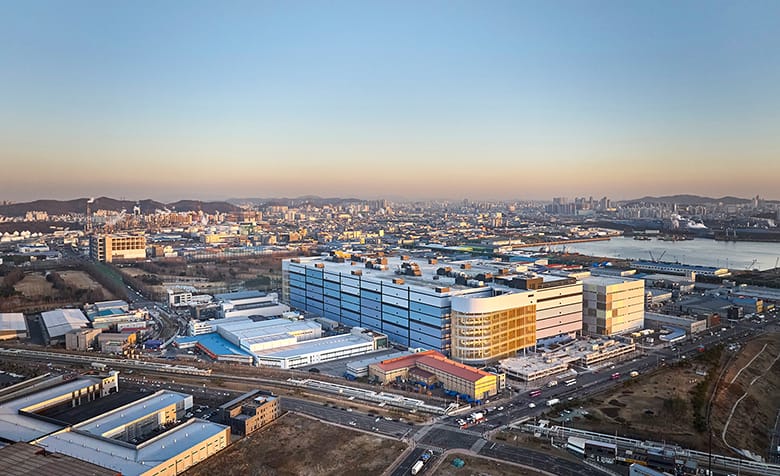
KKR’s Q4 purchase of Cheongna Logistics Center was Korea’s largest-ever single-asset logistics deal
KKR’s fundraising hit a record yearly high of $129 billion in 2025, driven by commitments to the private equity giant’s credit and infrastructure strategies.
Assets under management grew 17 percent for the year to $744 billion as fee-paying AUM rose 18 percent to $604 billion and fee-related earnings climbed 14 percent to $3.7 billion, the Manhattan-based firm said in results released Thursday. Full-year revenue fell 11 percent to $19.5 billion while attributable net income slid 27 percent to $2.25 billion, as insurance and investment gains eased from robust 2024 levels.
Also Thursday, KKR announced its $1.4 billion acquisition of Arctos Partners, an asset manager specialising in professional sports franchises. With $15 billion in assets under management, Dallas-based Arctos will form the basis of a new unit called KKR Solutions, which will serve as the home of a multi-asset-class secondaries business to be built over time, KKR said.
“Arctos has created a distinctive and scaled platform across sports investing and capital solutions for asset managers, and the team has extensive experience in secondaries — three areas where we see significant long-term opportunity,” said KKR co-CEOs Scott Nuttall and Joseph Bae.
Infrastructure Inflows
KKR said AUM in the real assets segment rose 16 percent to $192 billion last year, bolstered by $34 billion in new capital raised across infrastructure and real estate strategies.
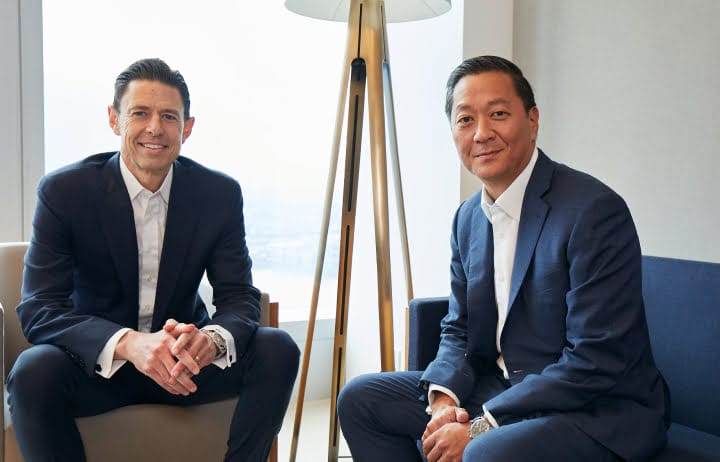
KKR co-CEOs Scott Nuttall and Joseph Bae (Image: KKR)
The fresh inflows included capital for a new fund, Asia Pacific Infrastructure Investors III, which began taking commitments last June and builds on KKR’s infrastructure franchise with over $83 billion in global AUM. The vehicle is aiming to raise between $7 billion and $9 billion to invest in sectors including data centres, utilities and transport.
KKR reported $27 billion in real assets investment during the year, with fourth-quarter deployment centred on US real estate credit and Asia infrastructure. The final weeks of 2025 saw the firm complete its $692 million purchase of Cheongna Logistics Center in South Korea from Brookfield, using funds from its Asia real estate strategy to clinch the country’s largest-ever single-asset logistics deal.
KKR was also among the biggest buyers of commercial assets in Japan last year, having purchased Nissan’s global headquarters in Yokohama for $630 million in November before teaming up with PAG to acquire Sapporo Real Estate in a $3 billion deal in December.
Those deals were in addition to KKR last February completing its successful tender for Japan’s Fuji Soft, which gave it control of the tech firm and its real estate portfolio at a $4 billion valuation. The company worked with Singapore’s Singtel during the year on a buyout of ST Telemedia Global Data Centres, finally announcing the $10.9 billion deal this week.
Aussie Energy Deal
Thursday also brought news of a KKR tie-up with Sydney-based HMC Capital under which KKR-managed funds will invest up to A$603 million ($420.7 million) into HMC’s energy transition platform.
KKR’s investment will support expansion of the platform, which currently spans 652 megawatts of operational assets and a 5.7-gigawatt wind and battery storage pipeline.
The deal seeks to facilitate Australia’s energy transition by bringing to market clean energy to support growing demand from consumer, industrial and emerging AI users over the coming decades, the companies said.
“KKR’s investment validates the quality of the platform we have built and sets the foundation for HMC to play a major role in Australia’s transition to net zero carbon by 2050,” said HMC CEO David Di Pilla. “KKR’s capital will enable the platform to materially grow operating capacity, cash flow and progress the strategically valuable development pipeline.”
Leave a Reply