
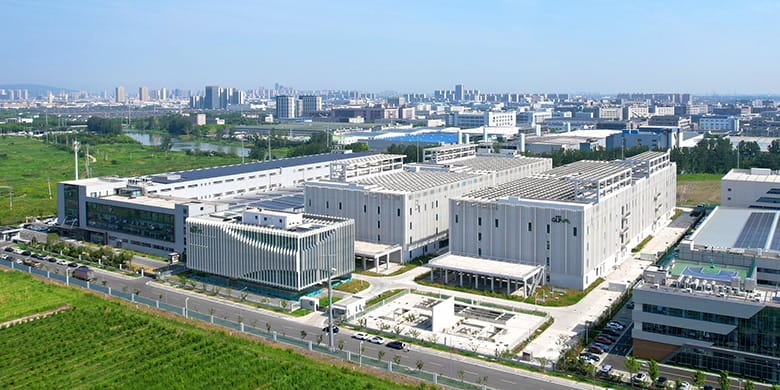
GLP handed over phase two of its120MW Changshui data centre last year (Image: GLP)
GLP’s China data centre business posted a 32 percent increase in annual revenue in 2025, as enterprise demand for AI computing drove the industrial developer’s digital platform to its strongest performance since the unit was established seven years ago, the company said in a Monday announcement.
The data centre business delivered more than 420 megawatts of IT capacity during the year, with its network of facilities in the Beijing-Tianjin-Hebei region, the Yangtze River Delta, the Greater Bay Area, and the Chengdu-Chongqing corridor continuing to expand.
The company’s 2025 data centre gains came as it continued to grow its core logistics business, where new and renewed leases reached 32 million square metres — up approximately 10 percent from 2024 — supported by domestic consumption growth, cold chain expansion, and rising demand for automated facilities.
“GLP responds to and supports the macro-trend of boosting domestic demand and industrial upgrading in the Chinese market, making firm investments and strategic deployments in the new economy sector, achieving steady growth,” GLP China chief executive Angela Zhao said.
Alibaba Cloud Switches On
Two of the year’s most significant deliveries went to one of China’s largest tech companies. GLP completed and handed over a pair of data centres to Alibaba Cloud in 2025, with both campuses now listed as active Express Connect access points in Alibaba Cloud’s public access point documentation.

Angela Zhao, CEO, GLP China
In October 2025 GLP announced that it had signed a digital infrastructure service contract with a leading technology company to occupy Phase II of its Changshu Southeast Data Centre in Changshu High-tech Industrial Development Zone in Jiangsu province.
That deal brought the120-megawatt campus converted from a logistics park to full capacity after GLP had delivered the first phase in 2021. Alibaba Cloud now lists the campus as access point Changshu-Bixi-A at GLP Changshu Pujiang Logistics Park in its Express Connect documentation.
Also during last year GLP converted nearly 20,000 square metres of space in a Dongguan facility to handle AI-level requirements with the upgraded GLP Dongguan Xiegang Data Centre in Guangdong province now listed as an Alibaba Cloud access point on the tech firm’s website.
Three converging forces drove demand for both campuses, GLP said: the rapid development of intelligent computing models, breakthroughs in domestically produced hardware, and improved efficiency from green technologies — together producing what the company described as an exponential increase in enterprise computing power requirements.
GLP’s Beijing Shunyi and Chongqing Liangjiang facilities also completed technology upgrades to serve Internet clients during the year.
Capital and Partnerships
GLP’s data centre expansion drew substantial institutional backing during 2025. In August, the Abu Dhabi Investment Authority invested $1.5 billion to become a strategic partner of GLP Group, building on existing fund-level cooperation.
Also in August, Zhejiang State-owned Assets Investment — backed by the Zhejiang provincial government — invested RMB 2.5 billion ($349.5 million) to take a strategic stake in the computing centre business. The transaction marked the first time GLP had opened its data centre unit to external strategic investors.
On the fund management side, GLP’s first data centre-themed fund completed fundraising in 2025, investing approximately RMB 2.6 billion in large-scale data centre projects developed and operated by the company. The GLP China Income Fund series, focused on logistics and manufacturing R&D infrastructure, completed its fourteenth fundraising round, deploying nearly RMB 2 billion.
Logistics Holds Steady
GLP China’s logistics and industrial infrastructure business also grew at a double-digit rate in 2025, in terms of area. Net absorption of warehousing space across more than 40 regional markets reached 16 million square metres for the year, a year-on-year increase of over 20 percent, GLP China said, citing market research.
GLP said its occupancy rate led the market, supported by structural drivers including e-commerce expansion into five western provinces, rising cold chain demand from international supermarket chains and growing take-up of automated warehouse systems.
The company’s first urban renewal project — the first phase of the Shanghai New Northwest Logistics Park — opened in September and reached occupancy above 90 percent almost immediately. The Western Bay Area Smart Industrial Park in Guangdong, a joint development with Xiyin spanning more than 600,000 square metres, was completed and handed over in December, making it GLP’s largest single development project to date.
The company had posted a $1.8 billion loss for the 2024 financial year due primarily to non-cash write-downs on its mainland China investment portfolio, although its data centre and logistics businesses continued to grow through that period.
Leave a Reply