
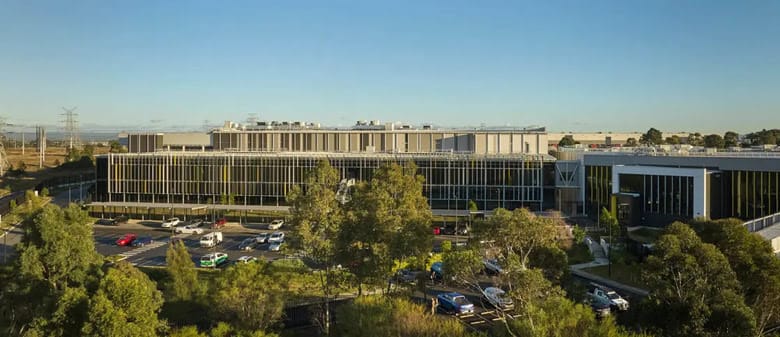
CDC’s Eastern Creek data centre campus in Sydney (Image: CDC)
CDC has secured Australia’s largest-ever data centre lease, signing a 555-megawatt agreement which more than doubles the sovereign infrastructure specialist’s contracted capacity to over 1 gigawatt.
The 30-year contract with an unnamed US customer, which includes renewal options extending the term by as much as 20 years, will see the capacity delivered across CDC campuses already under development and scheduled to become operational during fiscal 2028 and 2029, according to a Tuesday announcement by New Zealand infrastructure fund manager Infratil, CDC’s top shareholder.
The 555MW commitment equates to roughly 40 percent of operating capacity across all Australian data centres in 2025, based on CDC’s estimates from publicly available information, highlighting the scale of AI-related demand now sweeping the region.
CDC founder and CEO Greg Boorer said the pact marked “another massive tick of approval for Australia as a global hub for intelligence generation”, with the company having spent nearly two decades building sovereign infrastructure platforms capable of handling hyperscale AI workloads.
Capacity Race Heats Up
The agreement lifts CDC’s total contracted capacity beyond 1GW by fiscal 2029 from 220MW currently contracted for fiscal 2026, according to an investor presentation.

CDC founder and CEO Greg Boorer (Image: CDC)
Financial terms weren’t provided, and the client was described simply as “a United States high-end investment grade customer”. CDC tends towards secrecy on account of its government and sensitive infrastructure work, but US companies operating at such scale include database giant Oracle and tech titans Amazon, Google and Microsoft.
Canberra-based CDC said that its earnings before interest, tax, depreciation, amortisation and fair value adjustments are expected to exceed A$1 billion ($647 million) in fiscal 2028 and reach A$2 billion annually when the full 1GW of contracted capacity is deployed.
The deal cements CDC among the region’s largest hyperscale infrastructure operators as rivals race to secure power and land for AI deployments. Blackstone’s AirTrunk has announced more than 3GW of operating or planned capacity across Asia Pacific markets, while ASX-listed NextDC has flagged a long-term pipeline exceeding 1GW and Goodman Group commands a 6GW “global power bank”.
“Today’s announcement underscores Australasia’s opportunity to attract global computing capacity, supported by regional stability, competitive build costs and access to renewable energy,” said Infratil CEO Jason Boyes. “This contract reflects the strong global track record CDC has established in delivering large scale, future proofed and sustainable data centre campuses, and consolidates its position as the largest data centre provider across Australia and New Zealand.”
Maiden Melbourne Campus
CDC is owned by Wellington-based Infratil, which holds a 49.7 percent stake, alongside Australia’s sovereign Future Fund with 34.5 percent and state pension giant Commonwealth Superannuation Corporation with 12 percent, while CDC management has 3.7 percent.
CDC’s development programme comprises a 2.9GW pipeline, including 671MW of operating capacity, 572MW under construction and a further 1.66GW of future build capacity through fiscal 2034. Sydney represents the largest component of the future pipeline with 921MW of planned capacity, followed by Melbourne with 428MW, Auckland with 126MW, Perth with 101MW and Canberra with 73MW.
The company opened its first Melbourne campus earlier this year at Brooklyn in the city’s west, expanding beyond its core Canberra and Sydney strongholds as hyperscale and government demand pushes into new markets.
The latest contract reflects NZX-listed Infratil’s broader shift towards scalable digital infrastructure platforms. The fund manager last year sold its half-stake in retirement living operator RetireAustralia to Invesco as part of a A$845 million deal, with executives saying Infratil wanted to concentrate on businesses capable of scaling more rapidly, including data centres, renewables and digital connectivity assets.
Leave a Reply