
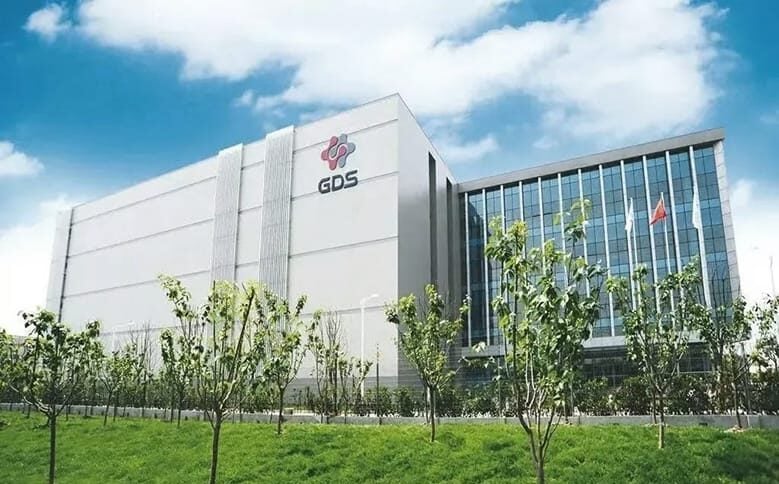
GDS sold a data centre in Kunshan to its C-REIT in 2025 (Image: GDS)
GDS Holdings reported net income of RMB 959.4 million ($139 million) in 2025, recording positive results for the first time since its 2016 NASDAQ listing, thanks to a series of asset monetisations, according to results released by the Mainland data centre giant on Tuesday.
The full year results were an improvement from GDS’ net loss of RMB 770.9 million in 2024, and came thanks to gains totalling RMB 3.15 billion from an asset-backed securities (ABS) issue, a C-REIT listing, and a share sale in its overseas arm DayOne, without which the company would have recorded a net loss of approximately RMB 2.2 billion for the year.
For its core operations, GDS fell short of profitability for at least the tenth consecutive year in 2025, while the company’s leadership pointed to progress under its proprietary adjusted EBITDA metric, which strips out share-based compensation, impairment charges and monetisation gains, in making its case to investors.
“We beat the top end of our adjusted EBITDA guidance, and with the contribution from asset monetization, we were free cash flow positive,” said William Huang, founder, chairman and chief executive of GDS.
One-Off Gains
For 2025, GDS’ revenue rose 10.8 percent from a year earlier to RMB 11.43 billion, and gross profit increased 16.3 percent to RMB 2.59 billion.

William Huang, chairman and chief executive of GDS Holdings also chairs DayOne (Image: GDS)
Under its adjusted EBITDA metric, GDS earnings grew 10.8 percent to RMB 5.40 billion for 2025 and the company achieved a margin of 47.3 percent. Allowing for net interest expenses of RMB 1.63 billion, depreciation and amortisation, as well as a RMB 1.56 billion impairment charge in the fourth quarter, GDS recorded a net loss from core operations of approximately RMB 2.2 billion.
The three transactions that generated GDS’ headline profit each involved separating assets from the company’s balance sheet and recognising a gain on the difference between their book value and the implied market value at which they were transferred.
In the first quarter, GDS sold a portfolio of data centre project companies into a special-purpose vehicle backed by a domestic ABS issue subscribed primarily by Chinese institutional investors, generating a deconsolidation gain of roughly RMB 1.06 billion.
In the third quarter, the company followed up by raising RMB 2.4 billion ($335 million) from the IPO of a C-REIT seeded with a 29MW data centre near Shanghai on the city’s stock exchange, booking a further RMB 1.37 billion deconsolidation gain.
DayOne Spin-Off Jumps 15x in Value
With data centres becoming a politically charged asset class, GDS rebranded its GDS International offshore business as DayOne in January of last year.
That rebranding helped set the company up to book a gain of RMB 715.9 million in the fourth quarter when it completed a Series C convertible preferred share fundraising for DayOne at a valuation of approximately $10 billion.
As part of that Series C round, GDS announced in January that DayOne would repurchase $385 million of its shares from GDS, in a deal which GDS informed investors in the NASDAQ-listed business would allow the company to recover 95 percent of its original outlay at nearly 6.5 times its original investment.
Huang, who chairs both GDS and DayOne, may see the value of GDS’ remaining stake in DayOne rise further, with the firm nearing a confidential filing for a US initial public offering at a valuation of up to $20 billion, according to a Bloomberg report on Monday.
That valuation for DayOne, which has data centre projects in Singapore, Malaysia, Indonesia, Thailand, Hong Kong, Japan and Finland, would be double the valuation implied in the Series C round roughly one year ago.
The reported US IPO valuation also represents an approximately 15 times increase over the $1.3 billion valuation set in the Series B in December 2024 when investors committed $1.2 billion to purchase convertible preferred shares in the company.
In its latest funding rounds GDS has brought on board international investors including US hedge fund Coatue Management, SoftBank Vision Fund, Citadel’s Ken Griffin and Boston-based Baupost Group, to join earlier backers including mainland China’s Boyu Capital and Chinese fund manager Zhang Lei’s Hillhouse Investment.
Gearing Up for Growth
GDS noted in an earnings call with investors that the company is experiencing high demand for its data centres, and has already taken steps to raise cash to develop more facilities.
In late January, the company announced a private placement of US$300 million of Series B convertible preferred shares to Chinese institutional investor Huatai Capital Investment, saying it would use the proceeds to fund data centre expansion and for general corporate purposes.
Daniel Newman, GDS’ chief financial officer, said in the earnings call that GDS is preparing to sell a second asset to its C-REIT, with that deal, which would provide additional cash for the company, expected to reach completion in the second half of 2026.
GDS is building up its war chest after new bookings — the gross additional area customers committed to occupy — rose 95.7 percent in 2025 to 96,766 square metres, which the company sees underpinning further expansion.
“During the year of 2025, we achieved the highest level of gross new bookings and gross move-in for the past five years. We strongly believe that demand will further accelerate during the AI era. Heading into 2026, we remain committed to disciplined and sustainable growth, viewing AI as a transformative catalyst for our long-term success,” said Huang.
The company founder said GDS is moving faster to secure additional powered land to support big data deployments.
GDS is working on a 3GW pipeline comprising big clusters in new markets which it sees as centres for growth, including Horinger in Inner Mongolia, Zhongwei in Ningxia Province, and Shaoguan in Guangdong Province. The firm has already won over 400 MW of new orders and memoranda of understanding for these locations, Huang noted.
“We are seeing robust recovery in data center demand across both new markets and established markets. It is exciting times to be a data center company again,” he said.
Leave a Reply