
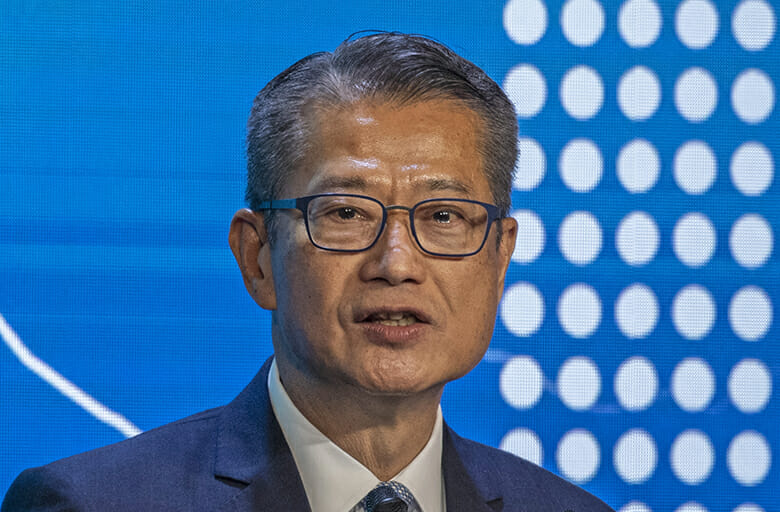
Hong Kong financial secretary Paul Chan (Getty Images)
Hong Kong is turning to the flood of wealthy investors picking up luxury homes in the city to shore up its finances as an ongoing office slump crimps the land sales revenue it has long relied on to run the city, according to the government’s new budget.
The city will raise stamp duty on residential property transactions valued above HK$100 million ($12.8 million) from 4.25 percent to 6.5 percent in a bid to increase revenue, financial secretary Paul Chan Mo-po said in his budget speech on Wednesday.
The measure will affect about 0.3 percent of residential property deals in the city and bring in around HK$1 billion of revenue per year, according to Chan. The change will be considered effective from Thursday, if it receives approval from the Legislative Council.
“Sentiment in the residential property market has turned positive,” Chan noted in his speech, with the move catching some analysts off-guard.
Surprised and Perplexed
“This is a surprising measure at a time when many private-sector market participants have been calling for further tax relaxation in the residential sector. Instead, the announcement goes in the opposite direction,” said Hannah Jeong, head of valuation & advisory services at CBRE Hong Kong. “At a time when transaction volume remains thin and sentiment is still recovering, raising upfront costs risks suppressing genuine upgrade demand and slowing capital circulation in the luxury segment.”
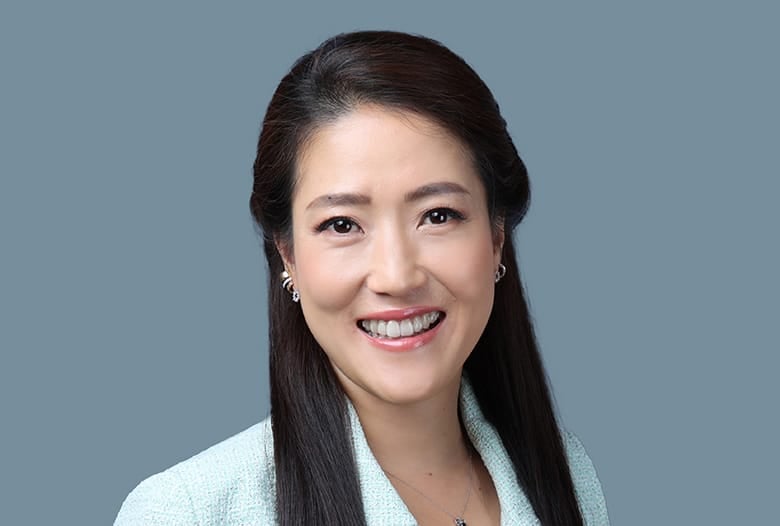
Hannah Jeong of CBRE
Joseph Tsang, chairman of JLL in Hong Kong, shared Jeong’s concerns over the tax hike. “The measure appears perplexing and will inevitably trigger a sharp short-term drop in transactions in this segment. It will likely take six to seven months for the market to digest the news before activity starts to pick up again,” he said.
Hong Kong recorded around 122 residential transactions of HK$100 million or more last year, the most since 2022, according to JLL. Developers have made several high-profile luxury property sales in the past few months, including Swire’s sale of a pair of super-luxury houses above Deep Water Bay for HK$2.2 billion in December.
Expecting the new measure to cause developers to revisit their price levels for luxury homes, CBRE’s Jeong forecasts that luxury residential prices will remain flat this year, after having earlier forecast a price increase of up to 5 percent.
Other analysts do not expect the measure to have significant impact on the city’s property market.
“While luxury homebuyers face higher stamp duty costs, these high-net-worth individuals are relatively less price-sensitive,” said Thomas Chak, head of capital markets & investment services at Colliers Hong Kong. “When compared to other major international cities, Hong Kong’s ultra-luxury residential market maintains a competitive edge in terms of its tax regime and investment value.”
Curbing Commercial Supply
After putting commercial land sales on hold in the 2025-2026 financial year, which ends 31 March, the city is extending the halt for another year.
“In view of the vacancy rate in the non-residential property market, the supply and demand, the government will not put up general commercial sites for sale in the coming year,” Chan said.
Analysts welcomed the government’s decision as supporting a commercial property market which has faced several years of declining rents and plummeting asset values. “It provides the office sector with more time to absorb existing supply and helps the office market stabilise,” said Alex Barnes, managing director for JLL Hong Kong.
Office rents are down nearly 42 percent from their 2019 peak, according to JLL, although Central district witnessed the beginnings of a rebound in the closing months of 2025.
Data Centre Dreams
While delivering the budget speech, Chan announced he will chair an initiative to deepen the integration of artificial intelligence (AI) technologies in Hong Kong, with an initial focus on life and health technology and embodied AI, such as smart robots.
The city will support the Committee on AI+ and Industry Development Strategy with a raft of funding, including seeking to inject HK$10 billion to speed up development of the Hetao Hong Kong Park, an innovation hub being developed in collaboration with neighbouring Shenzhen, as well as HK$2 billion to develop AI education programmes in primary and secondary schools.
Chan also noted that the HK$3 billion AI Subsidy Scheme launched by the city’s government has approved around 30 R&D applications in such fields as large language models, new materials and biomedicine to enhance local AI research standards and application.
“These initiatives will directly strengthen Hong Kong’s position as a regional technology hub and, importantly, will support a new wave of demand for data centres,” said CBRE’s Jeong. “With the renewed policy focus on AI+ and the expected easing of the interest rate environment, we anticipate data centre demand to rebound, driven by increased AI workloads, cloud adoption, and enterprise digitalisation.”
Following a data centre development boom from 2018 through 2022, the sector has faced a slowdown more recently as high interest rates pushed borrowing costs above data centre yields, suppressing investment appetite.
Jeong now expects data centre rents to stabilise this year before climbing from 2028 as the government’s AI initiatives begin to translate into capacity requirements.
Leave a Reply