
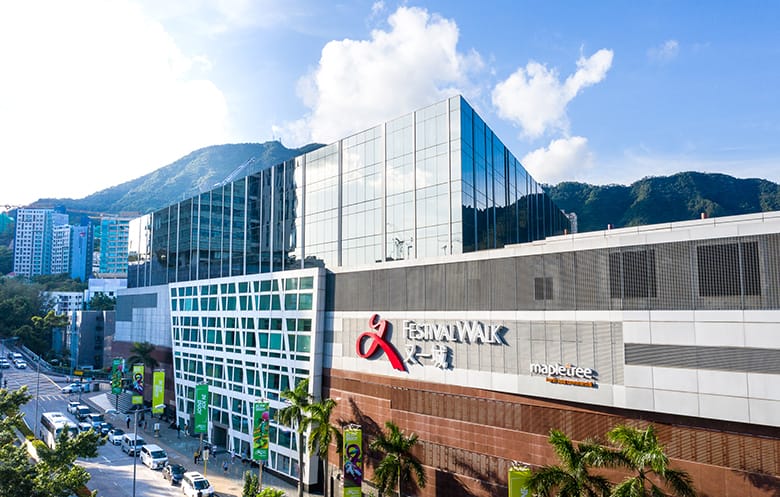
Festival Walk Tower stands opposite the City University campus (Image: MPACT)
Hong Kong has witnessed its second major sale of an office property in less than 24 hours, with the manager of Mapletree Pan Asia Commercial Trust (MPACT) announcing late Wednesday that it has agreed to sell part of the Festival Walk complex in Kowloon Tong for HK$1.96 billion ($$251.9 million).
The Singapore-listed REIT informed the bourse that it is selling Festival Walk Tower, the four-storey office element of Festival Walk, to an unrelated third party, without releasing additional details regarding the buyer’s identity. Sources familiar with the transaction identified the buyer to Mingtiandi as the City University of Hong Kong, which has its main campus across the street from the Festival Walk complex.
The deal leaves MPACT with the mall element of Festival Walk as the sole Hong Kong asset in its portfolio, with the office and retail complex having declined in value by S$223.6 million in its most recent financial year according to its annual report, to represent the biggest valuation loss on the REIT’s portfolio. MPACT said it would use the sale proceeds to reduce its debt.
For City University, the purchase marks the institution’s second major acquisition of a commercial property this year after the school in January closed on a HK$880 million deal for a retail podium in Tsim Sha Tsui.
More Room for Expanding Student Body
The deal provides City University with 213,982 square feet (19,880 square metres) of office space which is currently let to seven tenants, with 5.8 percent vacancy as of 30 September, according to MPACT’s statement.

Sharon Lim, CEO of Mapletree Pan Asia Commercial Trust’s manager
The office property was independently valued at HK$1.96 billion as at 30 November, the REIT said, and connects directly with Kowloon Tong MTR station. At the stated compensation, City University of Hong Kong is paying HK$9,160 per square foot for its new space.
The Festival Walk complex is across Tat Chee Avenue from City University, which said in September that it expects its admission of non-local students to increase by nearly 20 percent annually in the coming years.
That statement by the university came during that same month that the Hong Kong government announced that it had raised the cap on self-financing, non-local students at the city’s public universities from 40 percent to 50 percent of total enrollment for the 2026-27 academic year. The authorities had doubled the quota from 20 percent to 40 percent in 2023, with most of the non-local students coming from mainland China.
In its January acquisition City University acquired a retail podium at 94 Granville Road in Tsim Sha Tsui from HK$880 million from local investor Francis law, with that property changing hands at a 67 percent discount to its pre-pandemic asking price.
Top Deals Driven by Own-Use
Commercial property values in Hong Kong have declined by more than 50 percent in general from their 2019 peak, with investors seeking properties for their own use taking the opportunity to acquire premises at a fraction of earlier prices.
JD Property, the real estate investment division of JD.com, in a deal announced less than a day before Mapletree’s sale to City University, agreed to buy a half-stake in the China Construction Bank Tower in Hong Kong’s Central district, with the mainland e-commerce giant said to be planning to use the tower as its headquarters in the city. That deal ranks as the city’s third largest office deal of this year, according to MSCI
In October, JD rival Alibaba, along with its financial services affiliate Ant Group, bought the top floors of Jardine Matheson’s One Causeway tower in Hong Kong for $925 million to secure a new home in the city in Hong Kong’s largest property deal of this year.
The city’s second-largest office transaction this year also was also occupier-driven, with the Hong Kong stock exchange in April agreeing to buy a set of floors in the Exchange Square complex where it operates the local bourse from Hongkong Land for HK$6.3 billion.
Just over a year ago, Hong Kong Metropolitan University bought the former Cheung Kei Center office building in Kowloon’s Hung Hom area from receivers for a reported HK$2.65 billion, with the institution taking over the former corporate office block to expand its campus.
Leave a Reply