
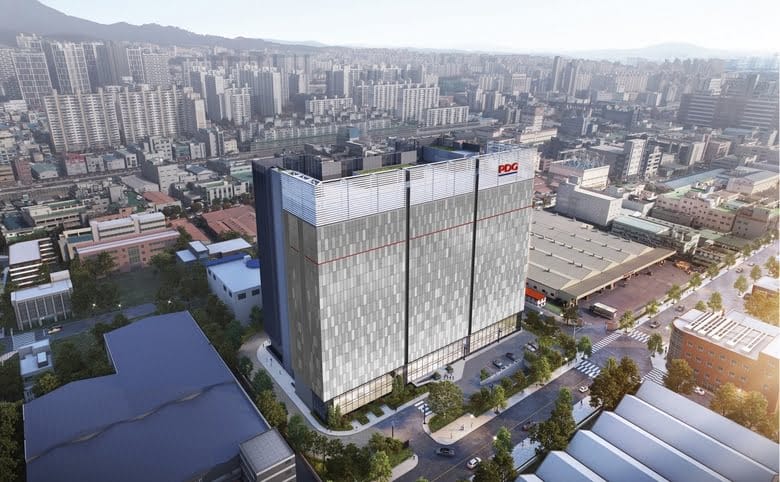
The planned data centre in Incheon (Image: Princeton Digital Group)
ESR and Princeton Digital Group on Monday announced the development of a 48-megawatt data centre in South Korea’s Incheon with a total investment of $700 million.
The initiative marks the first Korean data centre project for ESR and PDG, both of which are Singapore-based firms backed by private equity major Warburg Pincus. Development manager ESR will construct the core and shell of the data centre in partnership with Seoul-based Wide Creek Asset Management, while PDG will manage the internal fit-out and operations.
Scheduled to enter service in 2028, the Incheon campus is the first phase of PDG’s AI and cloud buildout plan for South Korea, where the company aims to develop multiple campuses totalling up to 500MW of IT capacity, it said in a release.
“South Korea is one of Asia Pacific’s most advanced digital economies and a critical market for cloud and AI hyperscalers,” said PDG co-founder, chairman and CEO Rangu Salgame. “Our entry is part of a long-term plan to be a significant provider of AI and cloud data centre capacity in the country.”
Hurdling Entry Barriers
The nine-storey data centre, designated as KR1 by ESR and SE1 by PDG, is set to begin construction this week on 11,000 square metres (118,403 square feet) of land in Incheon’s Bupyeong district. Power is fully contracted for the facility, which will feature high-density configurations, advanced cooling technologies and energy-efficient systems, PDG said.

Rangu Salgame, co-founder, chairman and CEO of Princeton Digital Group
The development of SE1 boosts PDG’s portfolio to over 1.2 gigawatts of IT capacity across seven countries, also including Singapore, Japan, India, Indonesia, China and Malaysia. The company made headlines in July when it announced that US private equity firm Stonepeak would invest $1.3 billion to purchase preferred equity in the company, contributing to a total of more than $3 billion in fresh cash raised this year.
“South Korea is one of Asia’s most mature and fastest-growing digital economies, but also one of its most complex markets, given land constraints, grid limitations, and stringent permitting requirements,” PDG said. “PDG’s entry into Korea demonstrates its ability to navigate these high-barrier-to-entry environments, supported by a multi-pronged market entry strategy and a proven track record across the region.”
In a separate statement, ESR co-founder and co-CEO Stuart Gibson labelled the project a milestone in the company’s pan-APAC data centre strategy of unlocking value across a 3.2GW pipeline of secured land and power across the region.
“South Korea stands out as one of Asia’s most dynamic and rapidly expanding digital economies and we are pleased to develop KR1 — our first data centre in the country,” Gibson said. “Strategically located in Incheon, a key business hub with world-class infrastructure, KR1 will position our customers and partners at the centre of this growth.”
Hyperscalers Up Bets
Particulars about the location of the Incheon project and the financial terms of the partnership weren’t provided.
ESR’s tie-up with Wide Creek comes after the Korean asset manager in September announced the acquisition of a greenfield site in Seoul’s surrounding Gyeonggi province for development of an 80MW data centre in partnership with Warburg Pincus and DC Connects.

ESR co-founder and co-CEO Stuart Gibson
The project in Yongin City followed the acquisition of two warehouse assets by the Warburg-Wide Creek JV after it was set up in 2023 to focus on investments in “new economy” real estate sectors like logistics, data centres, life sciences and business parks in South Korea.
Hyperscalers continue to up their bets in Asia’s fourth-biggest economy, with Amazon in October revealing plans to set aside an additional $5 billion for investment in South Korean data centres, on top of more than $4 billion in planned investment with partner SK Group announced in June.
In September, ChatGPT maker OpenAI hinted at the possibility of building a data centre in South Korea and expanding its cooperation with conglomerates like Samsung and SK.
Leave a Reply