
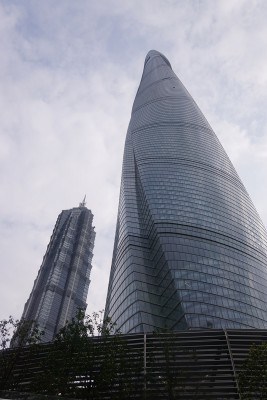
Alibaba’s Alipay affiliate takes up four floors in the Shanghai Tower as tech occupiers take over
The tenants occupying Asia’s prime office buildings have changed dramatically in the last thirty years with tech companies now taking up an estimated 20 percent of grade A space in some of the region’s largest office markets.
Despite the growing economic potential of technology, a survey of Asia-based real estate professionals conducted for Mingtiandi’s report, Building Asia’s Digital Future, revealed that the landlords developing the space occupied by tech giants such as Alibaba and Tencent have largely side-stepped the disruption that has shaken the manufacturing and media sectors.
Just as newspapers enjoyed geographic monopolies or oligopolies in their cities before the Internet took over media distribution, developers who have secured sites in prime locations have had the advantage of being able to offer tenants a product that is only available from a limited number of suppliers.
However, the rise of tech enabled co-working operators, who typically rely on online marketing and leasing systems to efficiently offer office space to tenants at competitive rates, is mounting a challenge to traditional office developers.
Wholesale Model Comes Under Pressure
 With their geographic advantage and limited group of competitors, developers of Grade A office buildings have been able to act as wholesalers of whole or half- floors of space to occupiers who must make long-term commitments to leasing large chunks of space , and then fit out their own offices.
Now, co-working operators, many of whom are converting underused space for use as high-end offices, are able to market their offerings directly to clients over the Internet, and this is beginning to encroach on the territory of office developers.
From March to August 2017, more than one-fourth of the space leased by WeWork in China was taken up by companies of more than 1,000 employees, according to a statement by the New York-based co-working operator.
The $20 billion office provider now counts multinational corporate occupiers such as lululemon,
Discovery Channel and Boston Consulting Group among its tenants in China. After raising $500 million from Japan’s Softbank and Beijing-based Hony Capital to expand its China operation, WeWork has also been able to win over mainland tech firms Zhaopin.com and bike-sharing startup ofo.
WeWork’s domestic rival, naked Hub, has reported similar results, with the Shanghai-based company counting major multinationals such as AB InBev and Viking Cruises among its tenants, as well as bike-sharing early mover Mobike, and Hong Kong’s Hang Seng Bank.
Co-Working Operators Start to Look Like Landlords
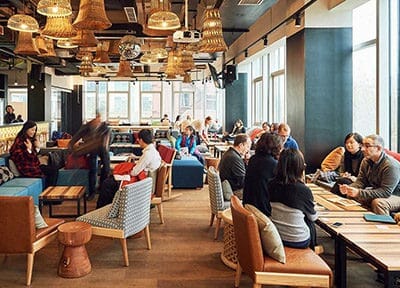
The success of Shanghai-based naked Hub is due in part to the company’s tech initiatives
Although co-working operators primarily operate as service providers for now, there are signs that WeWork, naked Hub and other flexible office firms are moving up the real estate value chain.
In October, the New York Times reported that WeWork is buying the Lord and Taylor department store in Manhattan for $850 million, with plans to move its corporate headquarters into the 63,000 square metre New York landmark. The company says it will lease the remainder of the space to tenants. During the same month, Bloomberg reported that WeWork is buying an office building in London from Blackstone for GBP 600 million ($785 million).
In Shanghai, naked Hub has taken over a 12,000 square metre building in the city’s Gubei area and
converted it into a tech friendly office centre. The two-year old company has now more than 80 percent leased the property after first opening for occupation in July. Earlier this month, WeWork leased a recently completed 27,000 square metre project near Shanghai’s Xintiandi, taking away, at least for now, naked Hub’s title for Asia’s largest co-working project.
Developers Get to Work on Flexibility
In a way similar to how traditional publishers bought into fast-growing websites in the first wave of online disruption of offline commerce, as co-working operators start to move into developer territory, some traditional builders have been finding ways to pursue this online-to-offline real estate opportunity.
On the mainland, office developer SOHO China has started its own co-working brand, SOHO 3Q, which now has some 19 centres nationwide.
In a move that bridges the mainland and Singapore markets, SGX-listed developer City Developments Limited (CDL) has has now led two fund-raising rounds totalling over $30 million for Shanghai-based co-working operator Distrii. And Southeast Asia’s largest developer, CapitaLand, is also catching on to co-working after having invested in Singapore startup The Great Room, and formed a partnership with WeWork for a project in Singapore.
With co-working operators becoming involved in real estate investment and development, and traditional developers co-opting innovations from flexible office providers, the shared office sector could rapidly become a major source of change in the region’s property industry, and one which Mingtiandi will track on a quarterly basis beginning in 2018.
This story is excerpted from Mingtiandi’s report, Building Asia’s Digital Future, which documents adoption of technological systems within Asia’s real estate industry. The report, and the survey it was based on, were sponsored by real estate investment and property management software provider Yardi Systems.
Leave a Reply